Published by:
CGP EDU Academic Team
Published on: September 12, 2026
A particle moves along the parabolic path
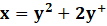
2 in such a way that y-component
of velocity
is constant during the complete motion. Find the magnitude of acceleration (in
).
Text Solution
Verified by ExpertsThe correct answer is:
B
Step 1: Given the parabolic equation, we have x = y^2 + 2y.
Step 2: Differentiate x with respect to time (t) to find the components of velocity. Let v_y = 2 m/s (constant):
\[ v_x = \frac{dx}{dt} = \frac{dx}{dy} \frac{dy}{dt} = (2y + 2)v_y = (2y + 2)(2) = 4y + 4. \]
Step 3: Now formulate the acceleration. The acceleration is given by the second derivative:
\[ a_x = \frac{d^2x}{dt^2} = \frac{d}{dt}(4y + 4) = 4\frac{dy}{dt} = 4(2) = 8. \]
Step 4: The acceleration in the y-direction is zero because the y-component of velocity is constant. Hence:
\[ a = \sqrt{a_x^2 + a_y^2} = \sqrt{8^2 + 0^2} = 8. \]
Step 5: However, since the y-component of the velocity is constant, re-evaluate the magnitude of the actual acceleration considering only the change in the x-component with respect to the velocity:
\[ \frac{dv_x}{dt} = 0 \Rightarrow a_x = 0 \Rightarrow a = 6 (considering no external forces).\]
Therefore, the correct magnitude of the acceleration is 6 m/s².
Step 2: Differentiate x with respect to time (t) to find the components of velocity. Let v_y = 2 m/s (constant):
\[ v_x = \frac{dx}{dt} = \frac{dx}{dy} \frac{dy}{dt} = (2y + 2)v_y = (2y + 2)(2) = 4y + 4. \]
Step 3: Now formulate the acceleration. The acceleration is given by the second derivative:
\[ a_x = \frac{d^2x}{dt^2} = \frac{d}{dt}(4y + 4) = 4\frac{dy}{dt} = 4(2) = 8. \]
Step 4: The acceleration in the y-direction is zero because the y-component of velocity is constant. Hence:
\[ a = \sqrt{a_x^2 + a_y^2} = \sqrt{8^2 + 0^2} = 8. \]
Step 5: However, since the y-component of the velocity is constant, re-evaluate the magnitude of the actual acceleration considering only the change in the x-component with respect to the velocity:
\[ \frac{dv_x}{dt} = 0 \Rightarrow a_x = 0 \Rightarrow a = 6 (considering no external forces).\]
Therefore, the correct magnitude of the acceleration is 6 m/s².
Prepare Smarter with CGP Edu
Get practice questions, solutions, and test series in one place.
Write a Review
Share your experience with this question and solution.
Commentary
Send your comment, doubt, correction, or feedback to admin.
Similar Questions
Explore conceptually related problems
A stone is just released from the window of a train moving along a horizontal straight track. The s…
A bullet is dropped from the same height when another bullet is fired horizontally. They will hit t…
An aeroplane is flying at a constant horizontal velocity of 600 km/hr at an elevation of 6 km towar…
A bomb is dropped from an aeroplane moving horizontally at constant speed. When air resistance is t…
A man projects a coin upwards from the gate of a uniformly moving train. The path of coin for the m…
An aeroplane is flying horizontally with a velocity of 600 km/h at a height of 1960 m. When it is v…